 USD
 KES - Kenya
 UGX - Uganda
 TZS - Tanzania
 RWF - Rwanda
 NGN - Nigeria
 ZAR - South Africa
 GHS - Ghana
 ETB - Ethiopia
 ZMW - Zambia
 USD - International

Picture a customer searching for your business online.
They find your website, tap the link and see:
“This site can’t be reached.”
For any business, even a brief outage can mean missed enquiries, lost sales and annoyed customers.
That is why website uptime is one of the most important things to weigh up when choosing web hosting in Zimbabwe.
Hosting companies often advertise figures like 99.9% uptime. It sounds nearly perfect, but what does it actually mean?
And is 99.9% good enough for your Zimbabwean website?
Let’s unpack it.
What Is Website Uptime?
Uptime is the amount of time a website or hosting server is available to visitors.
If your website stays reachable all month, it has very high uptime.
Downtime is the reverse: the time your website or server cannot be reached.
Downtime can be caused by:
- Server failures
- Hardware faults
- Network outages
- Software errors
- Security incidents
- Maintenance
- DNS problems
- Application errors
- Running out of resources
What Does 99.9% Uptime Mean?
When a host says it offers 99.9% uptime, it means the service is intended to be available for roughly 99.9% of the measured period.
The leftover 0.1% sounds tiny.
Over a year, though, it comes to about:
8 hours and 46 minutes of downtime.
Over a 30-day month, it is around:
43 minutes of downtime.
So 99.9% is good, but it does not mean your website will never go offline.
99.9% vs 99.99% Uptime
That extra “9” makes a surprisingly large difference.
| Uptime | Approx. downtime per year |
|---|---|
| 99% | 3 days, 15 hours |
| 99.9% | 8 hours, 46 minutes |
| 99.99% | 52 minutes |
| 99.999% | 5 minutes |
Across a 30-day month, 99.99% allows only about 4 minutes of downtime, compared with about 43 minutes at 99.9%.
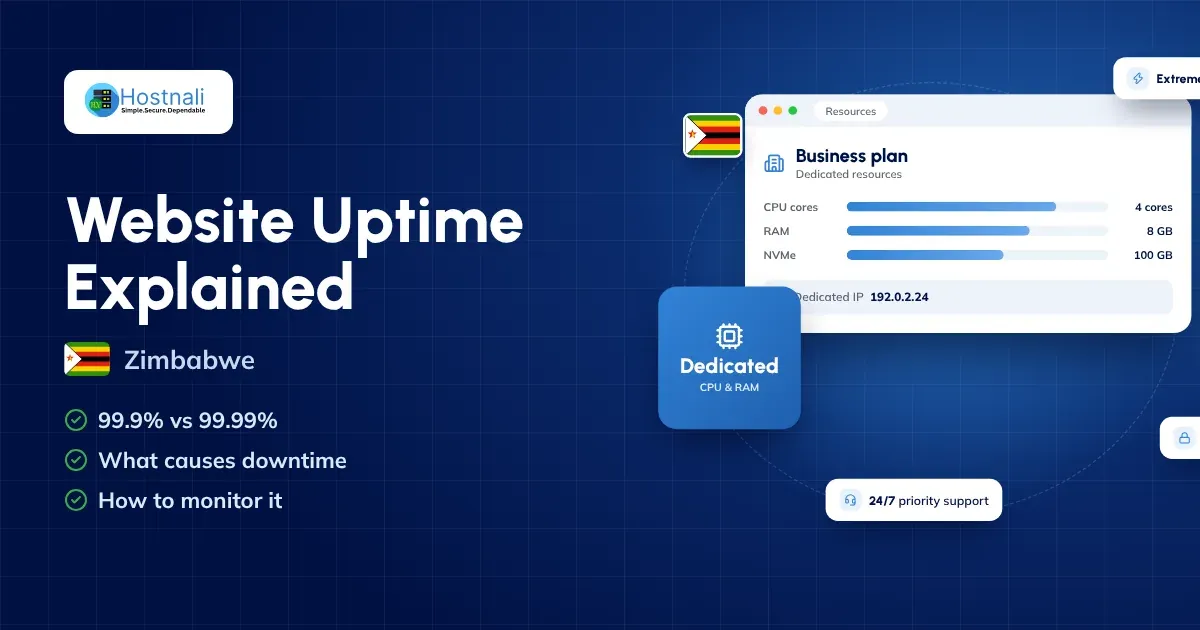
That is why businesses whose websites really matter to them look for hosting designed around higher availability. Hostnali guarantees 99.99% monthly uptime on its hosting and servers, backed by service credits.
Why Uptime Matters for Zimbabwean Businesses
Uptime matters most when your website is central to how you trade.
Take an online shop.
If the site goes down during a big promotion or the Christmas rush, customers cannot:
- Browse products
- Add items to their baskets
- Place orders
- Contact the business
The same is true for other organisations.
Schools
Pupils, students and parents may need:
- Enrolment information and forms
- Portals
- Announcements
- Learning resources
NGOs
Visitors may want to:
- Read about your programmes
- Submit applications
- Donate
- Get in touch
Businesses
Customers use websites to:
- Find your contact details
- Ask for quotations
- Book services
- Buy products
Whether a customer is in Harare, Bulawayo, Kwekwe or abroad in the diaspora, an offline website sends them elsewhere.
Is the Uptime Guaranteed?
Put this question to your hosting provider directly.
There is a big difference between:
“Our infrastructure targets 99.9% uptime.”
and:
“We provide a 99.99% uptime service-level guarantee under defined terms.”
If a provider advertises an uptime guarantee, read the terms.
Check:
- What is included?
- What is excluded?
- How is downtime measured?
- Is scheduled maintenance excluded?
- Are problems with your own website covered?
- Is there compensation?
- What conditions apply?
At Hostnali, the Service Level Guarantee is set out in our Terms of Use: if monthly uptime drops below 99.99%, you can claim a credit on that month’s fee by opening a ticket within 30 days. Don’t judge any host on the percentage alone; read how it is backed up.
What Causes Website Downtime?
There is no single cause.
1. Server Hardware Failure
Physical components can fail.
Good hosts have systems in place to detect and respond to hardware faults quickly.
2. Network Problems
A website becomes unreachable when there are connection problems between visitors and the hosting infrastructure.
3. Software Problems
Server software, applications or configuration mistakes can stop websites working.
4. Resource Limits
A website can get into trouble when it keeps going over its:
- CPU
- RAM
- Storage
- Database resources
- PHP workers
- Other plan limits
This is common with plugin-heavy WordPress sites or sudden surges in traffic.
5. DNS Problems
Incorrect DNS records can make a perfectly healthy server appear to be offline.
Typical DNS issues include:
- Wrong A records
- Wrong nameservers
- Expired domains
- Wrong MX records (email stops arriving)
- DNS propagation delays
6. Website Errors
Sometimes the server is fine and the problem lies in the website itself.
For example:
- A broken WordPress plugin
- PHP errors
- Database problems
- Faulty
.htaccessrules - A failed update
That is why a host’s uptime figure doesn’t mean every site on the server will always work.
Hosting Uptime vs Website Uptime
People often confuse the two.
Hosting Uptime
Whether the hosting infrastructure or service is available.
Website Uptime
Whether your own website is reachable and working.
Your hosting server could be online while your website displays:
500 Internal Server Error
The server is technically up, but your website isn’t working.
So monitor your actual website, not just your host’s uptime claim.
How Hosting Companies Improve Uptime
Reliable hosts use several methods to cut downtime.
Redundant Infrastructure
Important systems have backup components, so a single failure doesn’t take everything down.
Server Monitoring
Automated monitoring picks up problems and alerts the technical team around the clock.
Regular Maintenance
Proactive maintenance stops many failures before they happen.
Backups
Backups let websites and data be restored when something goes wrong. Hostnali’s shared, reseller and corporate plans keep daily, weekly and monthly restore points.
Network Redundancy
Several network paths make the service more resilient.
Resource Management
Allocating and watching server resources properly prevents performance-related failures. On Hostnali’s shared and cloud hosting, CloudLinux keeps each account isolated, so one busy site cannot drag its neighbours down.
How to Monitor Your Website’s Uptime
Don’t wait for a customer to tell you your website is down.
Website monitoring tools check your site every few minutes and alert you when:
- It goes offline
- It comes back online
- Response times become unusually slow
For any important business website, monitoring is strongly advised.
Speed and Uptime Are Different Things
A website can be online and still painfully slow.
For example:
Website A: Online, but takes 12 seconds to load.
Website B: Online, and loads in 2 seconds.
Both have uptime. Only the second gives visitors a good experience, and it uses less of their mobile data while they wait.
So don’t judge hosting on uptime alone. Look as well at:
- Server response time
- Storage technology
- CPU resources
- RAM
- Caching
- CDN compatibility
- Web server technology
Uptime and SEO
Search engines need to reach your website to crawl and index it.
Repeated or lengthy outages can cause SEO problems.
But don’t fall into the trap of thinking:
“99.9% uptime automatically means great SEO.”
SEO depends on many factors, including:
- Content quality
- Technical SEO
- Speed
- Mobile usability
- Internal linking
- Search intent
- Backlinks
- Security
- Crawlability
Uptime is one part of the technical foundation.
How to Choose Reliable Web Hosting in Zimbabwe
When comparing hosts, don’t just ask:
“Do you offer 99.9% uptime?”
Ask more searching questions.
1. What infrastructure do you use?
Look for modern, professionally managed servers.
2. How do you monitor your servers?
Good monitoring means problems are found and fixed quickly.
3. What happens when hardware fails?
Ask about recovery and redundancy.
4. Are backups included?
Backups are essential when something goes wrong.
5. What support is available, and when?
Fast support at any hour limits the damage. Hostnali’s team is available 24/7 by live chat and ticket.
6. Can I upgrade resources?
Growing websites need room to expand.
7. Is the uptime promise in writing?
A guarantee with clear terms and credits means more than a number on a homepage.
Why NVMe SSD Hosting Helps
Modern storage contributes to performance.
NVMe SSD storage is much quicker than older drives and suits workloads such as:
- WordPress
- Databases
- Online shops
- Web applications
Storage speed alone doesn’t guarantee uptime, though. A reliable hosting environment needs far more than fast drives. Read more in NVMe hosting in Zimbabwe.
Why Hostnali for Reliable Hosting?
Hostnali serves websites and businesses across Zimbabwe.
When you compare Hostnali or any other host, look at the whole package rather than a single number:
- A written uptime guarantee (ours is 99.99%)
- Server performance
- NVMe SSD storage
- Security
- Backups
- Technical support
- Scalability
- Resources
Hostnali offers everything from affordable web hosting and cloud hosting to VPS hosting and dedicated servers, so you can choose what fits your website, and pay by card, bank transfer or mobile money.
What to Do When Your Website Goes Down
If your website stops loading, don’t assume straight away that the server has failed.
Work through these steps.
Step 1: Check Whether It’s Just You
Try opening the site on another device or network, for example on mobile data instead of the office Wi-Fi.
Step 2: Check Your Domain
Make sure the domain hasn’t expired.
Step 3: Check DNS
Confirm that your DNS records point to the right server.
Step 4: Check Hosting Resources
In cPanel, look for CPU, RAM, storage or other resource-limit errors.
Step 5: Think About Recent Changes
Ask yourself:
- Did I install a plugin?
- Did I update WordPress?
- Did I change DNS?
- Did I edit
.htaccess? - Did I change PHP settings?
Step 6: Contact Support
If it looks like a server problem, contact your host. Hostnali clients can reach us at any hour by live chat or ticket.
How to Reduce Your Own Website’s Downtime
Your host isn’t the only factor. You can reduce website-related downtime too:
Keep WordPress Updated
Update WordPress core, themes and plugins.
Use Reliable Plugins
Avoid abandoned or poorly maintained plugins.
Keep Backups
Keep backups that you know you can restore. See how to back up your WordPress website.
Watch Your Resources
Keep an eye on CPU, RAM and storage use.
Secure Admin Accounts
Use strong passwords and two-factor authentication. More tips in how to secure your website from hackers.
Test Updates First
Where possible, test big changes on a staging copy before applying them to the live site. Every Hostnali plan includes WordPress staging.
Is 99.9% Uptime Enough for Your Website?
It depends on your business.
Personal Blog
99.9% is usually more than enough.
Small Business Website
99.9% is a reasonable minimum; 99.99% gives you more peace of mind.
Online Shop
Give more weight to availability, monitoring and redundancy: every minute offline is lost orders.
Financial or Mission-Critical Application
Higher availability needs may justify more advanced infrastructure.
Large Organisation
You may need custom infrastructure, redundancy and a formal service-level agreement.
The right level depends on what downtime would cost your business, in money and in reputation.
Frequently Asked Questions
What does 99.9% uptime mean?
It means a service is intended to be available for 99.9% of the measured period. Over a year, that allows roughly 8 hours and 46 minutes of downtime.
Is 99.9% uptime good?
Yes, it is a solid target for many websites, although businesses with critical sites may want higher availability, such as 99.99%.
Can a website have 100% uptime?
A site can record 100% uptime over a particular period, but no provider is completely immune to outages.
Does hosting uptime guarantee website uptime?
Not necessarily. Your website can have WordPress, database or DNS problems even while the hosting infrastructure is running normally.
Does uptime affect SEO?
Availability is part of a website’s technical health. Long or repeated outages cause crawling and user-experience problems, but uptime alone doesn’t decide rankings.
What’s the difference between 99.9% and 99.99% uptime?
99.9% allows about 8 hours and 46 minutes of downtime a year; 99.99% allows about 52 minutes.
What uptime does Hostnali guarantee?
99.99% monthly uptime on shared, WordPress, reseller, corporate and email hosting, VPS and dedicated servers, with service credits under our Terms of Use if we fall short.
Final Thoughts
99.9% uptime sounds a whisker away from 100%, yet it allows almost nine hours of downtime a year.
For most Zimbabwean business websites, 99.9% is a reasonable minimum. But the uptime percentage should never be the only thing you consider.
Look at the bigger picture:
Reliable infrastructure + monitoring + backups + security + performance + 24/7 support.
And remember that even with excellent hosting, your own website can still go offline because of a plugin, database, DNS or configuration problem.
Choose a host that gives you reliable infrastructure and the tools to keep your website online as your business grows.
Explore Hostnali hosting and choose the hosting that suits your website.