 USD
 KES - Kenya
 UGX - Uganda
 TZS - Tanzania
 RWF - Rwanda
 NGN - Nigeria
 ZAR - South Africa
 GHS - Ghana
 ETB - Ethiopia
 ZMW - Zambia
 USD - International

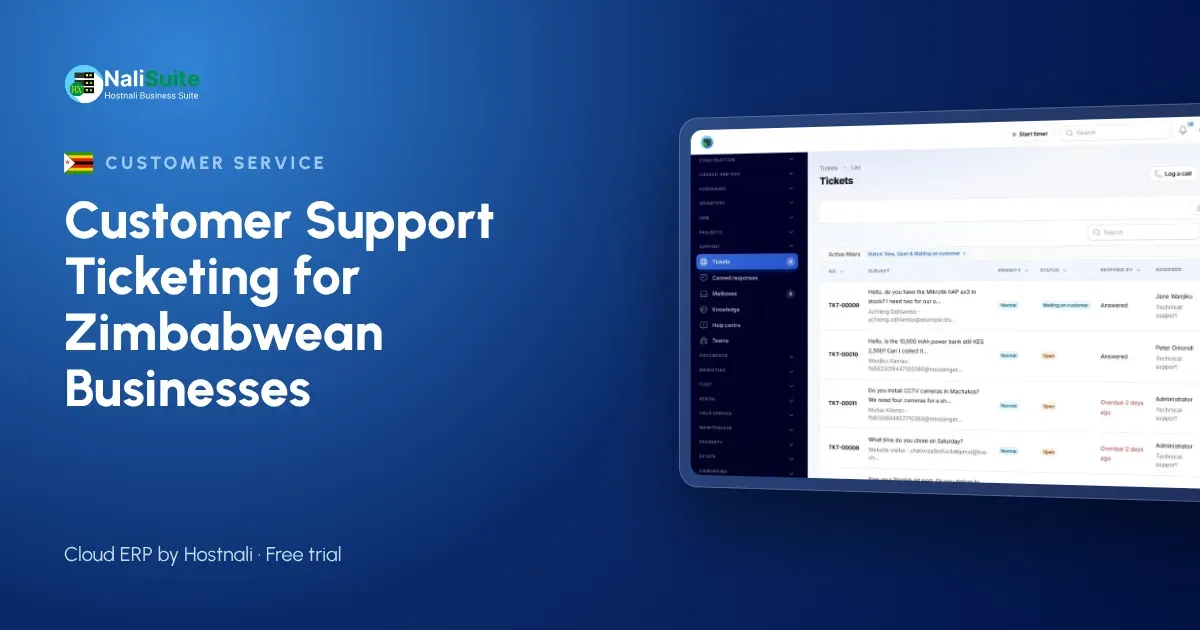
Zimbabwean business clients are demanding for good reason: they pay in hard currency and expect service to match. When a client’s request disappears into someone’s phone, the relationship suffers far more than the request itself. A ticketing system is the simplest way to show clients that every message is taken seriously.
We will look at five things clients expect from a support desk, using a security guarding company in Harare as the example, and how a ticket queue delivers each one.
The example: a guarding company in Harare
The company, based in Msasa, provides guards to offices, warehouses, schools and homes across Harare and Chitungwiza. It has a control room, an operations team and an accounts office. Clients contact it about guard no-shows, incidents, roster changes, extra guards for events and invoices.
For the guarding work itself, the Security services (guarding) add-on handles sites and posts, rosters, phone check-ins, patrols, an occurrence book and billing. Client requests are handled in NaliSuite Helpdesk.
Expectation 1: urgent problems handled first
A missing guard at a warehouse at 6pm matters more than a question about next month’s invoice.
How tickets deliver it: every request is given a priority, and Helpdesk tracks first-response and resolution targets for each, escalating tickets that are close to missing them.
| Priority | Example | First reply |
|---|---|---|
| Urgent | Guard absent from post, incident on site | 10 minutes |
| High | Roster change for tomorrow, complaint about a guard | 1 hour |
| Normal | Extra guards for an event next week, invoice query | 4 working hours |
| Low | General question, feedback | 1 working day |
These are examples; set targets your team can keep.
Expectation 2: one person who knows the story
Clients hate repeating themselves.
How tickets deliver it: each ticket has an owner and a full history. Email, web forms, phone calls logged by the control room, live chat, Facebook and WhatsApp through the WhatsApp Business Cloud API all arrive in one inbox (see the WhatsApp feature). Whoever picks up a follow-up sees everything said so far. Tickets are routed to teams, Control room, Operations and Accounts, and shared out by round robin within each team.
Expectation 3: a written record
When something goes wrong on site, the client wants to know what was reported, when and what was done.
How tickets deliver it: the ticket records every message and status change, from New to Open, Waiting on client and Resolved. For a dispute about a guard’s absence, the ticket and the add-on’s check-in records together give a clear account. Signed incident reports and contracts can be stored and signed online in NaliSuite Documents.
Expectation 4: quick, consistent answers
Clients expect the same answer whoever they speak to.
How tickets deliver it:
- Canned replies for common questions: how to request extra guards, notice periods for roster changes, how invoices are calculated.
- Help articles in a public help centre and in the customer portal for the same topics in more detail.
- AI drafts with the AI Business Assistant add-on, which drafts replies from the conversation and your articles using your own Anthropic API key. A team member always checks the draft before it goes out.
Expectation 5: billing they can trust
Invoice disputes damage trust quickly.
How tickets deliver it: extra guard hours requested through tickets are logged and billed, so nothing is charged without a record. Invoices are raised in USD from NaliSuite Invoicing, and clients can pay through online payments using the methods your payment provider supports, or by bank transfer, with each payment recorded against its invoice.
In the customer portal, clients see their invoices, open and follow tickets and download shared documents such as monthly reports.
What the numbers told the company
After two months of tickets, the Harare company could see:
- which sites generated the most urgent tickets, and which supervisors needed support;
- that first replies slowed during shift changes, so the control room rota was adjusted;
- that clients who used the portal raised fewer invoice queries.
Ratings after resolved tickets gave the managers a simple monthly measure of client satisfaction.
Personal information
Tickets hold client contacts, site details and sometimes information about guards and incidents. This is personal information under the Cyber and Data Protection Act [Chapter 12:07], with POTRAZ as the data protection authority. Keep it in the helpdesk, not on personal phones, and give each team access only to what it needs.
Shift changes in the control room
Guarding runs around the clock, so tickets often start on one shift and finish on another. Ask controllers to add a short note to every open ticket before they hand over. The next shift sees the latest status without phoning anyone, and clients are not asked the same questions twice in the middle of the night.
Frequently asked questions
Can the control room log phone calls as tickets?
Yes. Phone is one of the Helpdesk channels; the person who answers logs the call as a ticket.
Can clients open tickets themselves?
Yes. Clients can write in on any channel or open tickets in the customer portal.
Is ticketing useful for a small company?
Yes. Even a team of three benefits from one queue where nothing is forgotten.
Try NaliSuite
Every NaliSuite plan includes Helpdesk, Invoicing, Documents and the customer portal, from $2.10 a month. Compare the plans and connect your channels in a free trial.