 USD
 KES - Kenya
 UGX - Uganda
 TZS - Tanzania
 RWF - Rwanda
 NGN - Nigeria
 ZAR - South Africa
 GHS - Ghana
 ETB - Ethiopia
 ZMW - Zambia
 USD - International

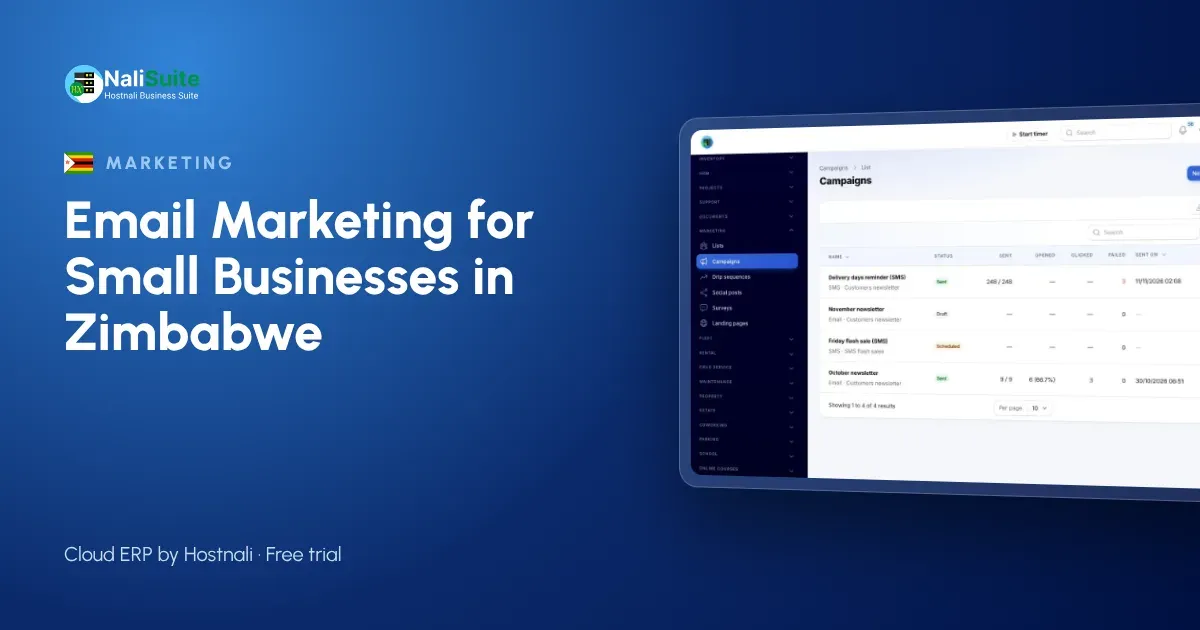
Zimbabwean businesses have two audiences that email reaches unusually well. One is local business customers: fleet managers, farmers, contractors and institutions who read email at work. The other is the diaspora: Zimbabweans in South Africa, the UK and elsewhere who pay for goods and services for family at home and who do much of their planning by email.
To show how email marketing works in practice, we follow an example business, a motor spares shop in Bulawayo, through its first campaigns. The shop is invented for illustration, but each step applies to most small businesses in the country.
Meet the example business
Ncube Motor Spares sells parts for the cars and light trucks common in Zimbabwe, does some fitting, and supplies a few small fleets. Customers include mechanics, fleet managers at schools and NGOs, and private car owners. Prices are in US dollars. Some customers are relatives abroad paying for repairs to a family car in Bulawayo.
The owner’s goal: bring customers back for servicing and parts before they go to a competitor.
Step 1: collect addresses with permission
The shop starts by asking. At the counter, staff ask customers whether they would like an email when service specials or new stock arrive, and record the answer. Fleet managers are asked by email. The shop’s website gets a short subscribe form, and its Facebook page pins a post linking to it.
In NaliSuite, every customer is already in the contacts app, with purchases attached. Customers who agree to marketing are tagged and added to a list in the marketing app. Those who do not agree stay in the records for invoicing but receive no marketing.
Step 2: set up a trusted sender
The owner stops sending from a free webmail address and uses a mailbox on the shop’s own domain, for example [email protected]. Hostnali’s email hosting provides the mailbox, and our support team helps set up SPF, DKIM and DMARC records, so emails are more likely to land in inboxes. Every email is signed by a real person with the shop’s phone number.
Step 3: split the list into segments
Different customers want different emails, so the shop creates three segments using tags:
| Segment | What they get |
|---|---|
| Fleet managers | Service scheduling, bulk parts availability, account reminders |
| Mechanics | New stock, trade availability, technical tips |
| Car owners, including diaspora relatives | Service reminders, seasonal checks, how to pay from abroad |
Step 4: write the welcome sequence
New subscribers get three automatic emails over a week, set up once as a drip sequence:
- Welcome. What the shop does, how often it emails, opening hours and location.
- Our service package. What a service includes, how long it takes and how to book.
- Common questions. Which parts are usually in stock, how fitting works, and how relatives abroad can pay by card.
Step 5: send the first campaign
Before the rainy season, the shop sends one email to car owners:
- Subject: Ready for the rains? Book a wiper, brake and tyre check
- Opening: Wet roads are no place for worn brakes.
- Body: a short list of what the check covers, how long it takes and that it can be booked online or by phone.
- Button: Book a check
- Sign-off: the service manager’s name and number.
Fleet managers get a separate email offering to schedule checks for their whole fleet. Mechanics get a stock email about brake pads and wiper blades.
Step 6: follow up on other channels
A few days later, opted-in customers receive a short reminder by approved WhatsApp template (see WhatsApp in NaliSuite) or by SMS through a supported SMS provider. The reminder is short and points back to the email’s details.
Step 7: look at the results
After a week, the owner looks at:
- opens and clicks, to see whether the subject line and offer worked;
- bookings, the number that matters;
- which segment responded best.
Because bookings and sales sit in the same system as marketing, with the CRM and sales apps, the owner can see which customers clicked and then booked. The lesson from the first campaign is written down and used next month.
Lessons for any Zimbabwean business
- Small, consented lists work. A few hundred interested customers are worth more than thousands of strangers.
- Segments beat one-size-fits-all. Even three segments make emails more relevant.
- Make payment clear. Say how customers, including those abroad, can pay.
- Keep it regular. One or two emails a month, every month.
Data protection: the Cyber and Data Protection Act
Zimbabwe’s Cyber and Data Protection Act [Chapter 12:07] covers personal information on your marketing list, with the Postal and Telecommunications Regulatory Authority of Zimbabwe (POTRAZ) as the data protection authority. Collect consent, explain what you will send, include an unsubscribe link in every email (NaliSuite adds one and skips opted-out contacts) and act on requests promptly. Check POTRAZ’s current requirements, including licensing of data controllers, for your business.
Frequently asked questions
Is email useful for reaching the diaspora?
Yes. Relatives abroad often plan and pay for services by email, so a clear email with payment details serves them well.
How often should I email?
Once or twice a month is enough for most small businesses.
Can I send SMS from the same system?
Yes. Connect a supported SMS provider and send SMS campaigns from the marketing app.
Does NaliSuite charge extra for email marketing?
No. The marketing app is built in to every plan, from $2.10 a month.
Try NaliSuite
Follow the same seven steps with your own customers. See the NaliSuite plans and start a free trial.