 USD
 KES - Kenya
 UGX - Uganda
 TZS - Tanzania
 RWF - Rwanda
 NGN - Nigeria
 ZAR - South Africa
 GHS - Ghana
 ETB - Ethiopia
 ZMW - Zambia
 USD - International

Zimbabwe’s workshops have learned to be resourceful: finding parts, keeping older vehicles running and dealing with customers who pay in different ways. Resourcefulness works best with good records behind it, so you know what was done, what it cost and who still owes you.
These tips are for Zimbabwean garages that want that control.
An example workshop in Bulawayo
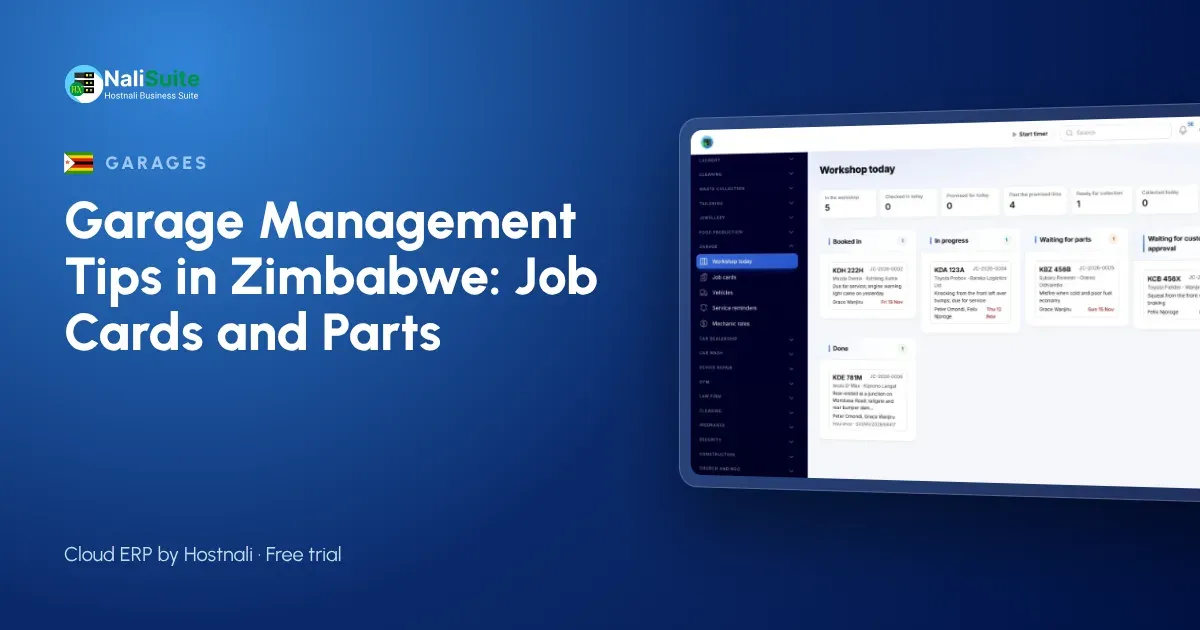
A workshop in Bulawayo services kombis and private cars. A kombi arrives with a starting problem. The job card records the odometer, fuel and the owner’s description. The estimate for a starter motor overhaul is sent by text and approved. Brushes and a solenoid are issued from stock against the job, labour is logged per mechanic, and the invoice in US dollars is ready on completion.
Get the estimate approved before the spanners come out
Customers rarely complain about a fair bill. They complain about a bill they did not expect. Once the fault is found, send an estimate that lists the parts, the labour and any outside work, such as machining or upholstery, and wait for a yes before work starts. Anything extra discovered later goes back to the customer as a new estimate.
The garage add-on sends estimates of parts, labour and outside work by email and text, and the customer approves them before work starts. The approval sits on the job card, so no one has to remember a phone call.
Open a job card the moment the car arrives
Most arguments in a workshop start with what the car looked like when it came in. Write it down before anyone touches it: the plate, the odometer reading, the fuel level, the customer’s complaint in their own words and a quick walk-round checklist for scratches, dents and missing items. A job card opened at the gate, not at the end of the day, becomes the record everyone works from.
Keep that record on a job card that follows the car through the workshop. With NaliSuite the card records the odometer, fuel level, complaint and checklist, and the vehicle is filed under its plate for next time.
Keep the full history of every vehicle
A car that comes back is the best customer a garage has. When it returns, the service adviser should see every past job card at a glance: what was replaced, when, at what mileage and what the mechanic noted for next time. It makes the conversation easier and the diagnosis faster.
NaliSuite’s garage and auto workshop add-on stores each vehicle’s service history by plate and texts the customer when the next service is due.
Zimbabwe: payments, fiscalisation and data
Many customers pay in US dollars by cash, card or bank transfer, and businesses will want your BP number on invoices. NaliSuite invoices carry a pay link through your own payment provider. If you must issue fiscalised invoices, check the current requirements with ZIMRA. Customer details are personal data under the Cyber and Data Protection Act.
Keep a tight grip on spare parts
Decide who can take parts from the store and make every issue go against a job. Count the fast movers, such as oil filters, brake pads and bulbs, every week. Set a reorder level for each so you are not sending a mechanic across town for a part you should have had on the shelf.
In NaliSuite parts are issued from stock to the job card, so the Inventory app shows what is left and what needs reordering, and the invoice picks up every part that was fitted.
Handle insurance jobs without chasing two payers
Accident repairs often have two payers: the insurer and the customer, who pays the excess. Agree with the customer who pays what before the job starts, and invoice each party for their share so neither invoice waits on the other.
The NaliSuite garage add-on can split the invoice between the insurer and the customer’s excess on insurance jobs.
Where workshops usually lose money
- Unapproved extra work that the customer refuses to pay for.
- Parts fitted but never charged.
- Mechanics’ time that nobody measures.
- Slow invoicing after the job is done.
- One-off customers who never come back for a service.
Each one is easy to fix once job cards, stock and invoices live in the same system.
Close the job, send the invoice, collect the money
An invoice written from memory at the end of the day always misses something. An invoice raised straight from the closed job card does not. Give the customer simple ways to pay, card or bank transfer, and record the payment against the invoice so the books stay right.
In NaliSuite invoices are raised on completion from the job card. Invoicing handles the pay link, and payments are matched to the invoice.
Where to grow next
Fleet maintenance contracts and a car wash are the two easiest ways for a busy garage to add steady income. Fleet clients expect service history, reminders and cost per vehicle; a car wash needs packages, a queue and commission for washers.
NaliSuite’s Fleet add-on and car wash add-on sit alongside the garage add-on, and the motor trade overview shows the full set.
Frequently asked questions
Can I invoice in US dollars?
Yes. You set the currency you invoice in, and payments are recorded against each invoice.
Is it affordable for a small workshop?
Yes. Plans start from $2.10 a month, and the garage and auto workshop add-on can be added to any plan.
Can customers approve estimates by text?
Yes. Estimates go by email and text and are approved before work starts.
Do I need to install software?
No. NaliSuite runs in the browser on a computer, tablet or phone, so job cards can be opened in the yard.
Try NaliSuite
Start a free trial of NaliSuite, add the garage add-on and open your first job card today. Plans start from $2.10 a month; compare the plans.