 USD
 KES - Kenya
 UGX - Uganda
 TZS - Tanzania
 RWF - Rwanda
 NGN - Nigeria
 ZAR - South Africa
 GHS - Ghana
 ETB - Ethiopia
 ZMW - Zambia
 USD - International

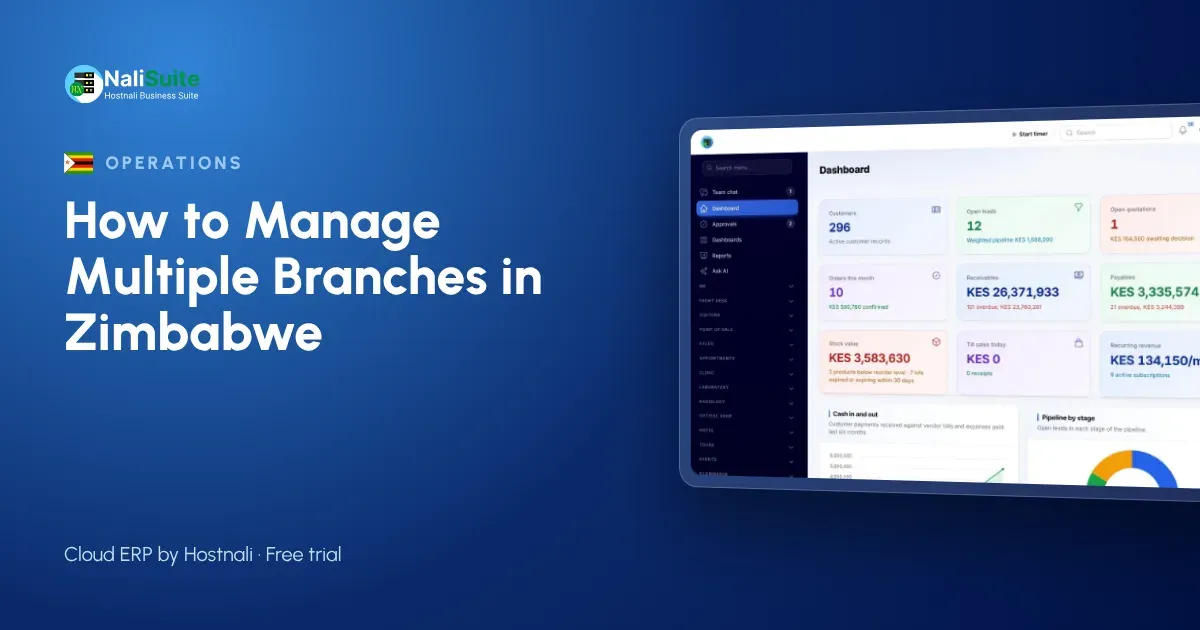
Running branches in Zimbabwe comes with its own challenges: cash in more than one currency, stock moving between Harare and Bulawayo, and prices that may need updating quickly. A system that shows each branch’s stock and takings clearly is what keeps the owner in control.
A familiar story
Consider a hardware chain with branches in Harare, Bulawayo and Mutare. Stock comes in through Harare, customers pay in US dollars and local currency, and each branch counts cash in both at closing. The owner struggles to know whether a shortfall is a counting mistake, a currency mix-up or something worse.
None of this is unusual. It is what happens when a business built around one owner in one place starts to run in several. The answer is not more WhatsApp groups. It is a system where every branch records the same things in the same way.
Stock per location
Every branch needs its own stock location, so the system knows that 40 units are in Harare and 12 in Bulawayo, not just 52 somewhere. NaliSuite Inventory keeps quantities per shop and warehouse, with reorder rules for each, and every sale at a till reduces stock at that branch only.
Transfers between branches
Most stock losses between branches happen in the gap between sending and receiving. Record each movement as a transfer: it leaves the sending branch, and is added to the receiving branch’s stock only when it confirms the quantities. A box that leaves Harare with 24 items and arrives in Mutare with 22 is caught on the day.
Cash control at each till
Cash is where small leaks become big losses. Open each till session with a counted float, take card, bank transfer or cash through the till rather than outside it, and close the session with a count. Any difference is recorded against that session, so a pattern at one branch stands out within weeks.
Agree a weekly routine too: transfers received, tills closed, a short check of fast movers in Gweru and the other branches. See the multi-company and branches page for how this works in NaliSuite.
Signs your branches need a system
- Branch managers in Bulawayo and Mutare phone each other to find stock.
- The end-of-day card payments and cash totals rarely match the sales book.
- Stock counts differ from what you expected by more than a few items.
- You cannot say which branch is most profitable without a week of work.
- Customers get different prices at different branches.
Moving from notebooks to one system
Start with one branch, usually the main shop in Harare, and run it on the new system for two weeks. Use that time to set up the product list, price list and till routine. Then add the other branches one by one, each with an opening stock count on the day it goes live. Within a month every branch records sales, stock and cash the same way, and the owner’s reports come from one place.
Train one person per branch properly rather than everyone a little. The supervisor in Bulawayo who knows the till, transfers and stock counts well becomes the person others ask, and problems in Mutare or Masvingo get solved on the spot instead of waiting for head office. Our team can help with the first imports and set-up.
Branches in Zimbabwe: local points
Where branches take more than one currency, count and record each currency separately at every till. Keep prices and stock values consistent across branches with one price list, and update it once when prices change rather than at each shop.
Zimbabwean businesses often adjust prices more often than businesses elsewhere. Keeping one price list for all branches, and updating it in one place, means every till and every invoice uses the new prices from the next sale. It also avoids customers finding different prices for the same product in Harare and Bulawayo.
Many Zimbabwean branches also sell on account to farmers, schools or contractors. Keep those customers in one shared list with credit limits, and send statements and reminders from the same system, so the Mutare branch can see that a customer still owes money in Harare before giving more credit.
Frequently asked questions
Can we invoice in US dollars and local currency?
Yes. Invoices and price lists can be in US dollars or another currency you set up. Decide how cash in each currency is counted at closing and keep to it at every branch.
How do I update prices at every branch at once?
Change the price list once; every branch’s till and invoices use the new prices.
How many branches can NaliSuite handle?
Every plan can run several branches; plans differ by users and storage. The Business and Enterprise plans suit larger teams, and Enterprise is made for groups and multi-company operations.
Try NaliSuite
NaliSuite runs inventory, point of sale, purchases and accounting for every branch in one cloud ERP, from $2.10 a month. Compare plans on the plans page and start a free trial.