 USD
 KES - Kenya
 UGX - Uganda
 TZS - Tanzania
 RWF - Rwanda
 NGN - Nigeria
 ZAR - South Africa
 GHS - Ghana
 ETB - Ethiopia
 ZMW - Zambia
 USD - International

Pricing in Zimbabwe has its own puzzles. Many businesses price in US dollars, some customers pay in other currencies, small change is scarce, and suppliers in South Africa or further afield set their own prices. Under all of that, the basics stay the same: know your cost, decide your margin, and keep both under review.
This guide covers how to set prices that cover your costs and still feel fair to customers in Harare, Bulawayo, Mutare or Gweru.
The cost floor: what one unit has cost you
Start by adding up everything it takes to get a product ready for sale:
- Purchase price from the supplier.
- Getting it here: transport from Beitbridge or a local wholesaler, border and clearing costs for imports, and fuel.
- Getting it ready: packaging, assembly, labels.
- Losses: damage, expiry and shrinkage.
- Overheads: rent, wages, power and generator fuel during outages, internet, and your own pay, shared across the units you sell in a month.
Divide by the number of units and you have the floor. Anything sold below it is a loss, however busy the shop feels.
Choose a margin, then check the arithmetic
Margin is profit as a share of the selling price. Markup is profit as a share of cost. They are not the same, and confusing them is one of the most common reasons small businesses earn less than they think.
| You want | Divide your cost by |
|---|---|
| 20% margin | 0.80 |
| 25% margin | 0.75 |
| 30% margin | 0.70 |
| 40% margin | 0.60 |
A product costing 8.00 needs a price of about 10.70 for a 25% margin, not 10.00.
Round prices sensibly
When small change is hard to find, odd prices create problems at the counter. Rounding helps, but round in a way that protects your margin:
- Round up to the nearest sensible figure for everyday items, and check the margin still makes sense to customers.
- Offer bundles – two for a round figure – rather than awkward single prices.
- For card and mobile payments, exact prices are fine, so you can keep a precise price on invoices for business customers.
Taxes on your prices
If your business is registered for VAT, part of each sale belongs to ZIMRA. Check the current rate and rules with ZIMRA, set them in your system, and calculate margins on prices before VAT. The free VAT calculator lets you enter the rate you use and work out prices with or without it.
Price for the customer in front of you
Different customers value different things:
- Retail walk-in customers compare shelf prices and value convenience.
- Contractors and farmers buying in quantity expect a better price for a bigger order.
- Companies and NGOs want a formal quotation, an invoice with the right details and often payment terms.
- Diaspora buyers paying for goods delivered to family care about trust and delivery.
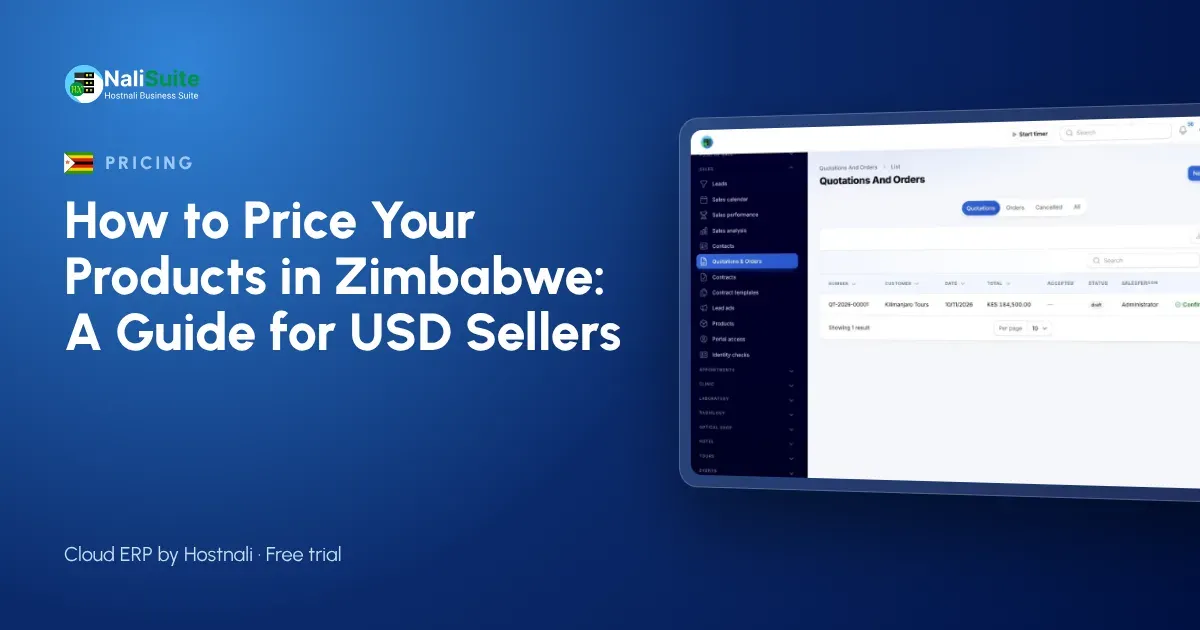
Separate price lists for these groups stop staff improvising. In the NaliSuite sales app, you can keep price lists by customer group, currency or quantity, and run promotions with a start and end date. The point of sale uses the same lists at the till.
A worked example
A hardware shop in Bulawayo sells wheelbarrows. Using plain example numbers:
- Purchase price: 32.00.
- Transport from the wholesaler: 2.50.
- Share of overheads: 3.50.
- Full cost: 38.00.
For a 25% margin: 38.00 ÷ 0.75 = 50.67. The shop prices the wheelbarrow at 51.00 for walk-in customers and quotes 48.00 each for contractors buying five or more, which is still well above cost.
Keep costs and prices in step
Supplier prices change, and a price set six months ago may be close to cost today. Each time new stock arrives, record its real cost, including transport and duty. NaliSuite inventory adds these landed costs to the cost of goods, and accounting shows gross margin by product, so you can see at a glance which prices need attention.
When you change a price, change it everywhere at the same time, and keep honouring quotations you have already sent until they expire.
Pricing services and labour
Many Zimbabwean businesses sell labour as well as goods: installing the gate they made, fitting a solar system, repairing a vehicle. Price labour from its full cost too – wages, transport to site, tools, and the hours lost between jobs – and show it separately on quotations. Customers then see what they pay for parts and what they pay for skill, which makes the price easier to accept and harder to haggle down.
Frequently asked questions
Should I price in US dollars or ZiG?
Use the currency your customers pay in and the one your costs are in. NaliSuite supports price lists in more than one currency, so you can keep both if you need to.
How do I deal with customers who want a discount for cash?
Decide in advance whether you offer one and how much. If you do, put it in a price list so it is applied consistently.
What margin should a small shop aim for?
It depends on how fast items sell and what your overheads are. Work out your floor first, then choose a margin that covers slow periods and leaves you a profit.
Try NaliSuite
NaliSuite keeps landed costs, multi-currency price lists, quotations and the till in one system. Plans start at $2.10 a month, shown in US dollars, with a free trial. See the plans.