 USD
 KES - Kenya
 UGX - Uganda
 TZS - Tanzania
 RWF - Rwanda
 NGN - Nigeria
 ZAR - South Africa
 GHS - Ghana
 ETB - Ethiopia
 ZMW - Zambia
 USD - International

Zimbabwean businesses often juggle several currencies, several bank accounts and card payments at the same time. A supplier in Bulawayo might bill in US dollars, receive some payments in local currency and take card payments in the shop. Reconciliation is how you make sure all of that ends up correctly recorded.
What makes it harder here
- More than one currency. Invoices, receipts and bank accounts may not share a currency, so exchange differences need recording.
- Several accounts. Separate USD and local-currency accounts each need their own reconciliation.
- Card settlements. Card sales arrive in batches, net of fees, a day or more after the sale.
The routine
Gather statements per account
Download a statement for each bank account and each card settlement report for the same dates.
Reconcile each account in its own currency
Match receipts to invoices and payments to bills within each account. Do not mix USD and local-currency lines.
Record conversion and charges
Where a USD invoice was paid in local currency, or the other way round, record the payment at the rate actually applied and post the exchange difference. Post bank and card fees as expenses.
Confirm the balances
Each account in your books should end on its statement balance.
A short checklist
| Item | Done? |
|---|---|
| All statements downloaded for the same dates | |
| Receipts matched to invoices | |
| Card settlements split into sales and fees | |
| Exchange differences recorded | |
| Transfers between own accounts recorded once | |
| Book balances agree with statements |
Records for ZIMRA
Reconciled books, with the currency of each transaction clear, make your returns to ZIMRA easier to support. Check the current fiscalisation and filing requirements with ZIMRA.
In NaliSuite
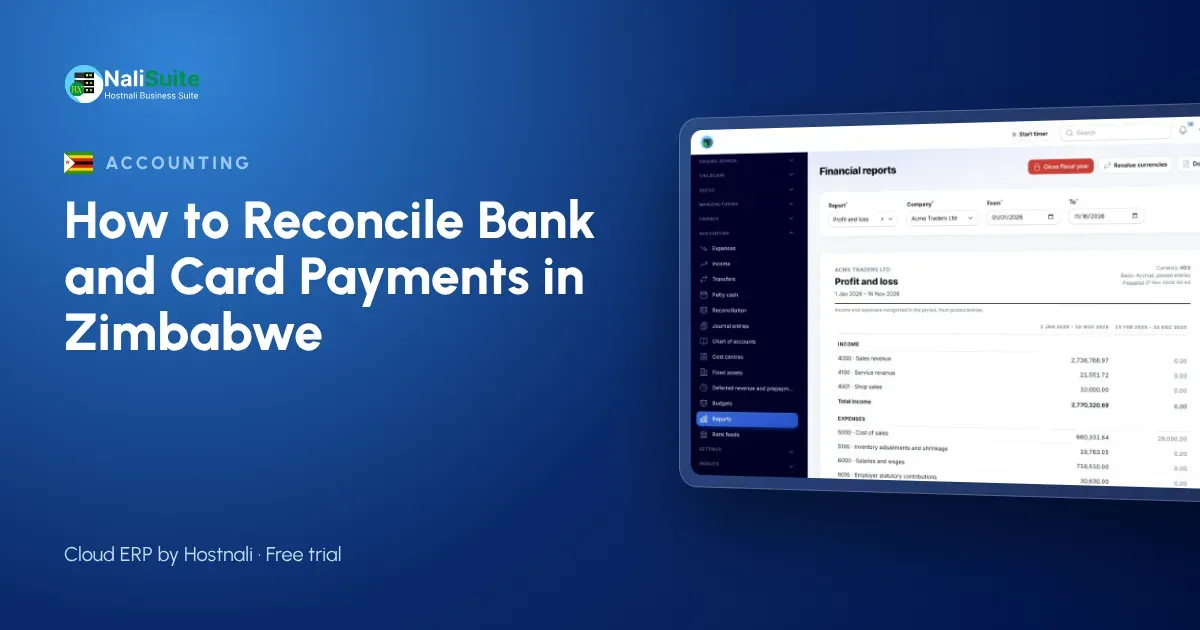
NaliSuite Accounting keeps accounts in more than one currency and imports bank statements with suggested matches. Card and bank payments taken through online payment links close invoices automatically. The bank reconciliation feature explains the matching.
Card settlements across two currencies
A pharmacy in Bulawayo accepts cards for both USD and local-currency sales. Settlements land in two different accounts, each net of fees, on different days. The weekly routine is to download each settlement report, split each payout into the day’s sales and the fee, and match it within its own account. Mixing the two currencies in one reconciliation is the most common cause of balances that never agree, so keeping them strictly apart saves hours. It also makes the month-end review with your accountant far quicker, because each account tells its own clear story.
A second example: a Gweru engineering firm
An engineering firm in Gweru invoices mines and farms for repairs, some in US dollars and some in local currency, and receives payments into separate accounts. Large clients often pay several invoices together. The firm reconciles each account weekly in its own currency, splits combined payments across invoices using the client’s remittance, and records any difference between the invoiced rate and the rate applied as an exchange gain or loss.
Mistakes to avoid with multi-currency books
- Recording a USD payment into a local-currency account in the books, or the other way round.
- Using one rate for the whole month when payments were converted at different rates.
- Forgetting bank charges in either currency.
- Leaving unidentified receipts without follow-up.
Who should reconcile, and how often
Reconcile each currency account weekly and review the month together with your accountant. Assign the task to someone who does not receive payments, so the check is independent. Keep a log of each reconciliation with the rate used for any conversion and the open items still to follow up. Over time, that log also shows which customers regularly pay in the wrong currency or without references.
Frequently asked questions
Can I invoice in USD and receive local currency?
Yes. Record the payment at the rate applied and post any exchange difference.
Should each currency have its own bank account in the books?
Yes. Reconcile each account separately in its own currency.
How often should I reconcile?
Weekly for most businesses; daily if you take many card payments.
Can one invoice be paid partly in each currency?
Yes. Record each part in its own account at the rate applied, against the same invoice.
How do I choose the exchange rate to record?
Use the rate actually applied to the payment, and record any difference from the invoice rate separately.
What if a payment arrives without a reference?
Match it by amount, date and payer, confirm with the customer, and ask them to quote the invoice number next time.
Should card fees be recorded in each currency?
Yes. Record each fee in the currency of the account it was charged to.
Can staff reconcile on my behalf?
Yes. Give them access to the statements and the books, and review their work monthly, especially the exchange differences and any unidentified receipts.
Try NaliSuite
NaliSuite starts from $2.10 a month. Compare the plans.