 USD
 KES - Kenya
 UGX - Uganda
 TZS - Tanzania
 RWF - Rwanda
 NGN - Nigeria
 ZAR - South Africa
 GHS - Ghana
 ETB - Ethiopia
 ZMW - Zambia
 USD - International

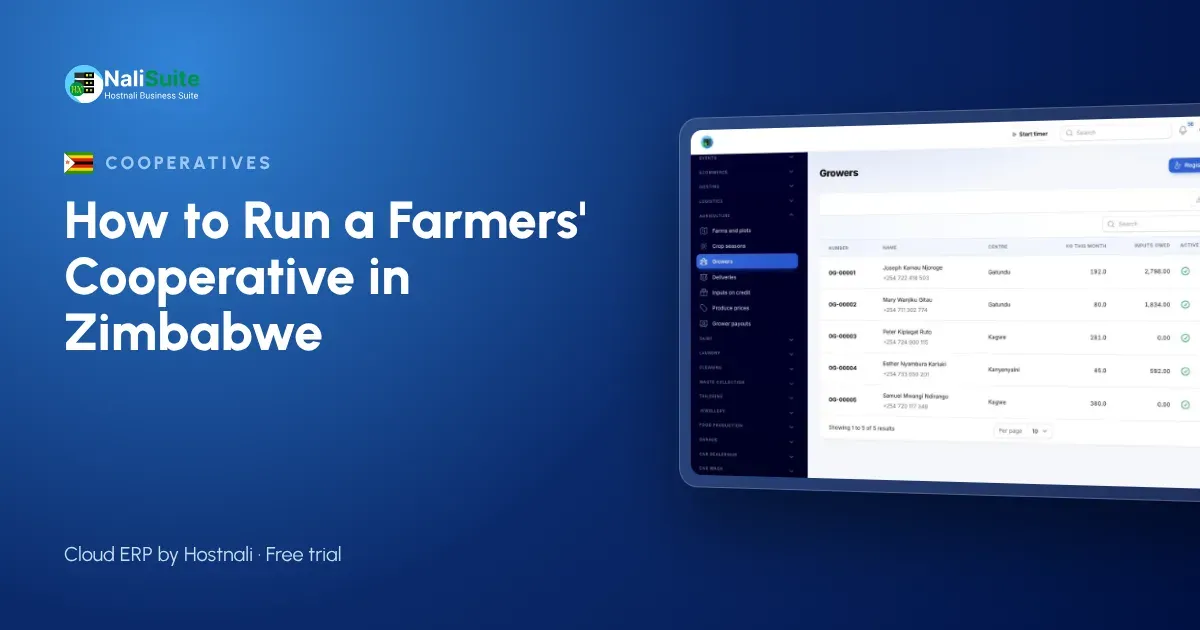
Zimbabwean cooperatives bring together smallholders growing horticulture, grain, cotton and dairy, often supplying contractors or processors who prefer to deal with one organised group. Running the group well means accurate delivery records, careful tracking of inputs given on credit and payouts that members can follow. This guide sets out a practical routine.
Members first: a register you can rely on
Treat the member register as the cooperative’s most valuable document. Each entry needs the member number, full name, phone, payout details, route or centre, joining date and a contact person in the family.
Limit who can change payout details, and keep a note of every change and who made it. A changed phone number or bank account is the easiest way for money to go astray.
A worked example: a horticulture group in Mashonaland East
Think of a horticulture cooperative in Mashonaland East whose members grow vegetables for a supermarket supplier. The buyer provides seed and fertiliser on credit and pays the cooperative per kilogram delivered, by grade. The cooperative then has to split each payment between members. When every crate is weighed and graded against the member, and the buyer’s input credit is recorded against each grower, the split is calculated in one step.
Make the collection point the source of truth
The collection point is where errors either start or stop. Capture each intake as it happens, with the member number, quantity, grade and the price that applies on that day, and give the member a receipt by text.
For milk, record morning and evening intake separately and reject deliveries that fail the quality check at the door, rather than arguing about them at month end.
Advances, inputs and store credit
Members often take seed, fertiliser, feeds, veterinary drugs or a cash advance before they are paid. Record every item against the member on the day it is taken, with its value.
That way the payout calculation already knows what to recover. Each item appears as its own line on the statement, so members can see that what was deducted is what they took.
Paying members and choosing a currency
Most Zimbabwean cooperatives price and pay in US dollars, by bank transfer or in cash at the depot. Agree the payout currency and method in writing with members at the start of the season, and record each payout in that currency so statements are easy to follow.
Where cash is used, count it in front of two committee members and record each payment with a signed receipt, so the cash book and the member statements always agree.
Deductions members can understand
Deductions are the most common cause of complaints. List them clearly: what the item is, when it was taken and how much is being recovered this period.
If a member’s deductions are larger than their earnings for the month, carry the balance forward rather than paying them nothing without explanation, and tell them before payday.
Running the payout
A good payout takes hours, not days. Earnings from deliveries, minus each member’s deductions, give the amount due. The committee reviews and approves the list, and members are paid by bank transfer or in cash at the depot, in the currency agreed with members.
Record every payment as it goes out and reconcile the account afterwards, so any failed payment is spotted and resent the same week.
Reporting to members and the board
Members want their own statement; the board wants the whole picture. Produce both from the same records: a statement per member after each payout, and a summary of deliveries, sales, deductions and payouts for the board.
Keep the books for the cooperative itself in the same system, so the annual accounts come straight from the records members already see.
How NaliSuite helps cooperatives
NaliSuite is a cloud ERP that runs a cooperative’s records in one place. The Dairy Cooperative Milk Collection add-on organises members on collection routes, records morning and evening intake with a density check, sends a text receipt for every delivery and works out monthly payouts after the levy, share contributions and store credit. For crops, the Agriculture and Outgrowers add-on weighs and grades collections, gives inputs on credit and settles what each grower is owed.
If members also save and borrow through the group, the SACCO and Microfinance add-on keeps savings, shares and loans with guarantors next to their deliveries. Payments can be collected and sent through your payment provider, and the cooperative’s own books stay in Accounting. See the farms and cooperatives section for everything that applies to your sector.
A note on member data: the register holds names, phone numbers and payment details, so treat it carefully. In Zimbabwe that means following the Cyber and Data Protection Act, with POTRAZ as the data protection authority. Limit who can see member records and never share lists outside the cooperative.
Frequently asked questions
Can we keep the books in US dollars?
Yes. The cooperative can price deliveries, record credit and pay members in US dollars, with statements in the same currency.
How do we handle input credit from a buyer?
Record the inputs against each member when they are issued and deduct them from that member’s share of the buyer’s payment, with each deduction shown on the statement.
Will it work at collection points with weak internet?
Clerks can record deliveries on a phone or laptop in the browser; plan for a working connection at each centre, or record at the main office the same day.
How long does it take to set up?
Most cooperatives start with the member register and one collection point, then add the others once the first is running smoothly.
Try NaliSuite
The best way to judge it is to try it with your own members. A free trial lets you set up the register, record deliveries and run a test payout before committing. Compare the plans.