 USD
 KES - Kenya
 UGX - Uganda
 TZS - Tanzania
 RWF - Rwanda
 NGN - Nigeria
 ZAR - South Africa
 GHS - Ghana
 ETB - Ethiopia
 ZMW - Zambia
 USD - International

For a Zimbabwean supplier, a quotation carries more risk than in most countries. Prices change, the currency of payment has to be agreed, and a quote that stays valid too long can turn a profitable job into a loss.
This guide walks through the quotation process from the customer’s first question to the final invoice, with the extra care Zimbabwe’s two-currency trading needs.
1. Clarify the job
A school in Bulawayo asks a contractor to quote for repainting six classrooms. Before pricing, the contractor confirms:
- the size of each room and whether ceilings are included;
- the paint quality and colours;
- when the work can be done (holidays only?);
- who will approve the quote and how payment is usually made.
Every answer changes the cost. A site visit is often worth the time.
2. Agree the currency first
Ask the customer which currency they will pay in, and state it clearly on the quote. If you accept more than one currency, say whether the price differs, and which exchange rate applies if they pay in the other. Write this into your terms rather than settling it at the end.
3. Price every cost
- Materials at today’s supplier prices, with a note of when you checked them.
- Labour in days, per worker.
- Transport, including fuel.
- Equipment hire, such as scaffolding.
- Your margin.
If materials must be paid for in advance at supplier prices that change weekly, your quote must reflect that, either through a short validity period or a deposit.
4. Write the quotation
A complete Zimbabwean quotation includes:
| Section | What to include |
|---|---|
| Your details | Business name, address, phone, email, BP number, VAT number if registered |
| Customer | Name, organisation, contact person |
| Reference | Quote number, date, validity (for example 7 days) |
| Currency | “All prices in US dollars” or as agreed |
| Scope | Rooms, surfaces, materials and what is excluded |
| Lines | Item, quantity, unit price, total |
| Tax | VAT on a separate line if you are VAT-registered |
| Payment | Deposit, balance, methods |
| Terms | Timeline, changes in scope, warranty |
| Acceptance | Signature or online link |
VAT rates in Zimbabwe have changed in recent years, so confirm the current rate with ZIMRA before adding it, and do not charge VAT if you are not registered. The free VAT calculator lets you type in the rate yourself.
5. Send it as a proper document
A price in a WhatsApp message is easy to misquote and hard to approve. Send a PDF or link that the customer can forward to whoever signs off.
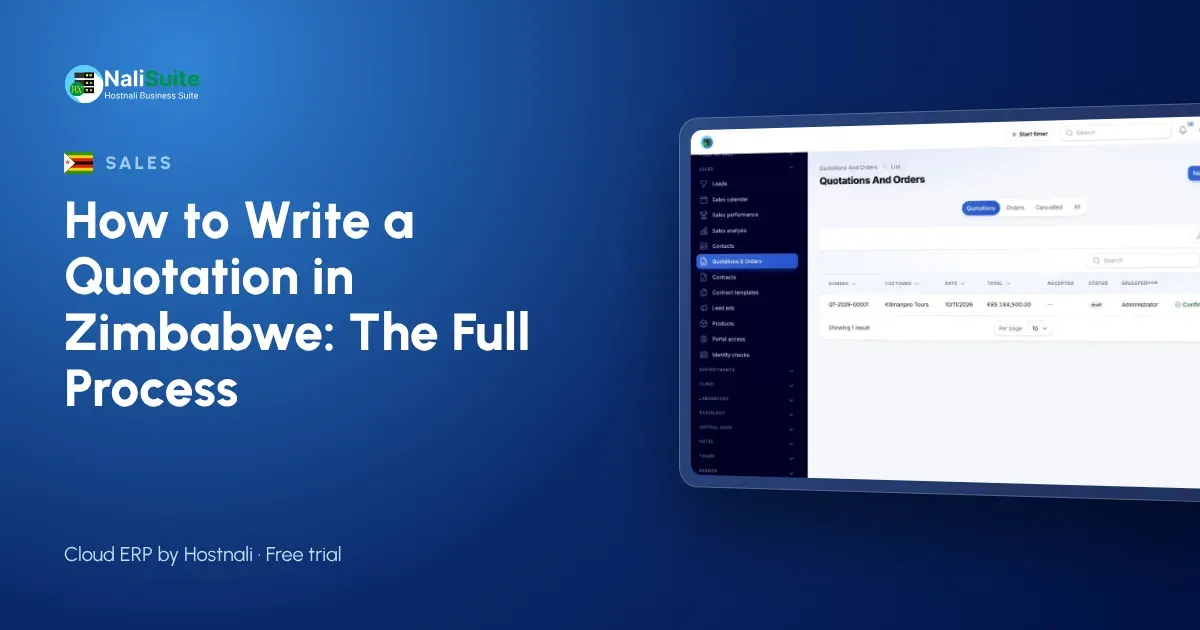
NaliSuite Sales and Quotations builds quotations from your products and price lists, with prices by customer group or currency, and sends them as branded PDFs by email or WhatsApp. The customer can accept online, and you are notified at once.
6. Follow up within a few days
Call or message the customer two or three days after sending. Check that the quote arrived, ask whether anything needs changing and find out when they will decide. If your validity period is short, remind them of the date.
Keep track of each quote’s status in the CRM app, so none are forgotten.
7. When the price must change
If the customer asks for a lower price, change the scope or terms: fewer coats, a different paint, a longer payment period. If your costs have risen before acceptance, issue a revised quote with a new reference rather than absorbing the increase.
8. From accepted quote to invoice
Once the quote is accepted:
- Confirm the order and the currency in writing.
- Invoice the deposit and buy materials when it is paid.
- Complete the work and invoice the balance.
In NaliSuite, the accepted quotation becomes an order and then an invoice, with deposits and partial invoices supported. NaliSuite Invoicing can send invoices with a link to pay online through the provider you connect; see online payments.
Common pitfalls
- Long validity on volatile prices. Keep it short and explain why.
- Currency left unstated. Leads to disputes at payment time.
- No deposit on materials-heavy jobs. You end up financing the customer.
- Scope too loose. “Painting works” invites arguments about ceilings, doors and window frames.
Vendor registration with larger buyers
Corporates, NGOs and public bodies in Zimbabwe usually need suppliers registered before they can accept a quote. They often ask for company registration documents, a BP number, a tax clearance certificate and bank details. Keep these in one folder and check expiry dates, because an expired tax clearance can stop a payment until it is renewed.
Frequently asked questions
Should I quote in US dollars or local currency?
Quote in the currency you and the customer agree on, and state it clearly. If you accept both, explain how the other currency is calculated.
How short should validity be?
Many Zimbabwean suppliers use 7 days for materials-heavy quotes. Use a period that matches how often your supplier prices change.
Do I need a BP number on my quotation?
Corporate and public buyers often ask for it, along with tax clearance. Including it saves a step.
Can I change the price after the customer accepts?
Only if your terms allow it. That is why validity and price-change clauses matter.
Try NaliSuite
NaliSuite helps Zimbabwean businesses quote, invoice and track payments in one system, with price lists for different currencies and customer groups. Plans start at $2.10 a month with a free trial; see the plans or learn about NaliSuite.