 USD
 KES - Kenya
 UGX - Uganda
 TZS - Tanzania
 RWF - Rwanda
 NGN - Nigeria
 ZAR - South Africa
 GHS - Ghana
 ETB - Ethiopia
 ZMW - Zambia
 USD - International

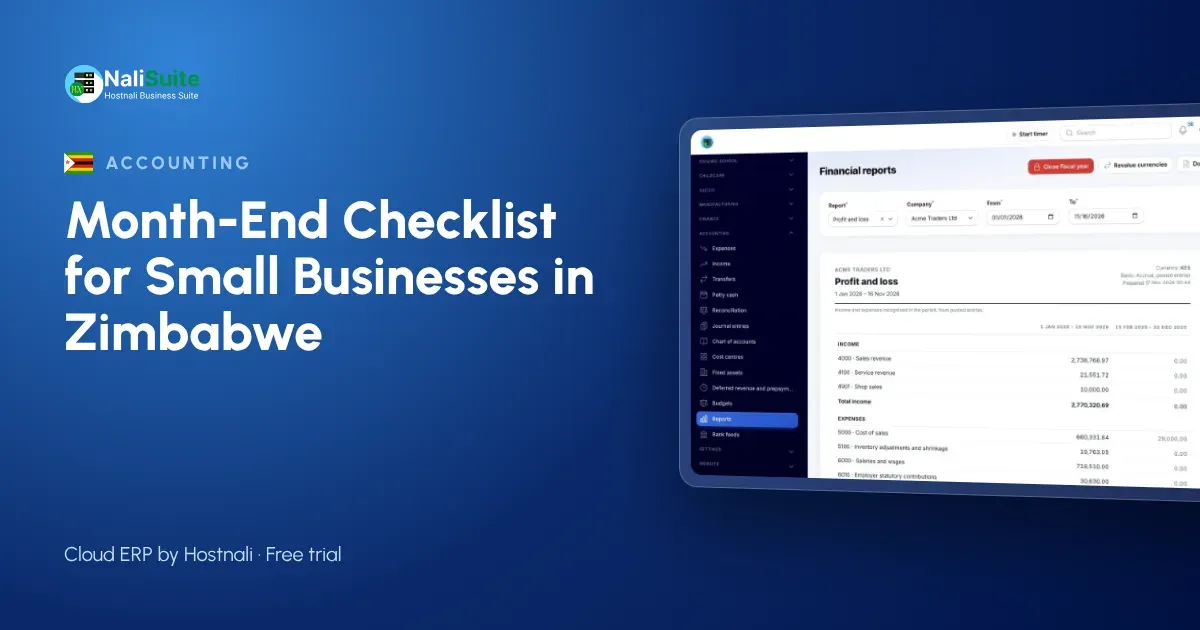
Zimbabwean businesses close the month with an extra layer of work. Sales arrive in US dollars and sometimes in local currency, much of it in cash, and every figure has to be recorded in the right currency before anything can be added up.
This checklist groups the close into five areas. Work through them in order, and keep the currencies separate until the very end.
First, decide your currency rules
Before your first close, agree three things with your accountant:
- Which currency your books are kept in.
- How you record sales and costs in the other currency.
- Which exchange rate you use when you convert, and where you get it.
Write these down. A close is only consistent if the rules are the same every month.
Area one: cash and bank
Most small businesses in Harare, Bulawayo and Mutare still handle a lot of cash. Start here.
- Count the cash in each till and safe, separately for each currency.
- Compare the count with the cash sales recorded in the till for the month.
- Bank statements. Download each account’s statement, US dollar and local, and link every credit to a sale or invoice.
- Card and online payments. Check the settlement report from your payment provider against the sales recorded, and record the charges.
Anything that does not match goes on a list with a date and the person checking it.
NaliSuite Accounting imports bank statements and proposes a match for each line. The bank reconciliation feature explains how it works.
Area two: suppliers and costs
- Record every supplier bill for the month, in the currency it was issued in.
- Check that what was billed was actually received.
- Record cash purchases with receipts, including fuel bought for generators and vehicles.
- Include bank charges and any transfer fees.
If you prepay suppliers, as many Zimbabwean businesses must, record the prepayment as money the supplier owes you until the goods arrive.
Area three: customers
List unpaid invoices by age, in each currency. For each one, choose an action: a reminder, a call, a statement or a stop on further credit.
With NaliSuite Invoicing, invoices can be sent by email or WhatsApp with a link to pay online. The online payments feature explains how payments are recorded against the invoice.
Area four: stock and wages
Stock
Count your most valuable items and your fastest sellers. Record stock in the currency you bought it in, and note differences with a reason. In a business where prices change often, an accurate count also tells you what your stock is really worth.
Wages
- Confirm that wages for the month were approved and paid.
- Record the deductions you are required to make as amounts owed until paid.
NaliSuite’s payroll app lets you set up the deductions that apply to your business and produces payslips for each employee. Check the current deduction rules with ZIMRA and the relevant authorities.
Area five: tax, reports and lock
Tax
If your business is registered for VAT, compare VAT on sales with VAT on purchases, in each currency, before converting as your rules require. VAT rates and filing rules should be checked with ZIMRA, as they are updated from time to time. The free VAT calculator lets you type in the current rate yourself.
Reports
Read the profit and loss, the balance sheet and the aged debtors list. In a two-currency business, also look at the balances held in each currency. A strong profit figure means little if most of it is sitting in a currency that is losing value.
Lock the period
Lock the month when you are satisfied. Corrections after that are made on purpose, with a note explaining why.
A worked example
A hardware shop in Gweru sells in US dollars and local currency. For months the owner added both currencies together at the end of the month, using whatever rate came to mind. The profit swung wildly. After agreeing a fixed approach with an accountant, recording each sale in its own currency and converting at month end using one documented rate, the swings disappeared. The owner could finally see that one product line was making a loss once its US dollar cost was considered.
Quick tips
- Keep separate tills or cash bags for each currency.
- Ask customers who pay by transfer to quote the invoice number.
- Match bank statements weekly rather than once a month.
- Store receipts for cash spending in one folder per month.
Frequently asked questions
Should I keep separate books for each currency?
Usually not. Keep one set of books with each transaction recorded in its own currency, which accounting software can handle. Your accountant will advise on the reporting currency.
How do I record a sale paid partly in US dollars and partly in local currency?
Record one invoice and two payments, each in its own currency. The system then shows the invoice as fully paid.
What if I cannot get a bank statement on time?
Use your own records of deposits to start matching, then complete the match when the statement arrives.
Is a monthly close really necessary for a small shop?
Yes. In a multi-currency economy, a month is long enough for small mistakes to become large ones.
Try NaliSuite
NaliSuite gives Zimbabwean businesses invoicing, bank matching, stock and payroll in one cloud system. Plans start at $2.10 a month with a free trial; see the plans or learn more about NaliSuite.