 USD
 KES - Kenya
 UGX - Uganda
 TZS - Tanzania
 RWF - Rwanda
 NGN - Nigeria
 ZAR - South Africa
 GHS - Ghana
 ETB - Ethiopia
 ZMW - Zambia
 USD - International

In Zimbabwe, where many businesses price and pay in US dollars, every purchase is real money out of the till. An agro-dealer in Mutare or a hardware shop in Gweru cannot afford to pay twice or pay for stock that never arrived.
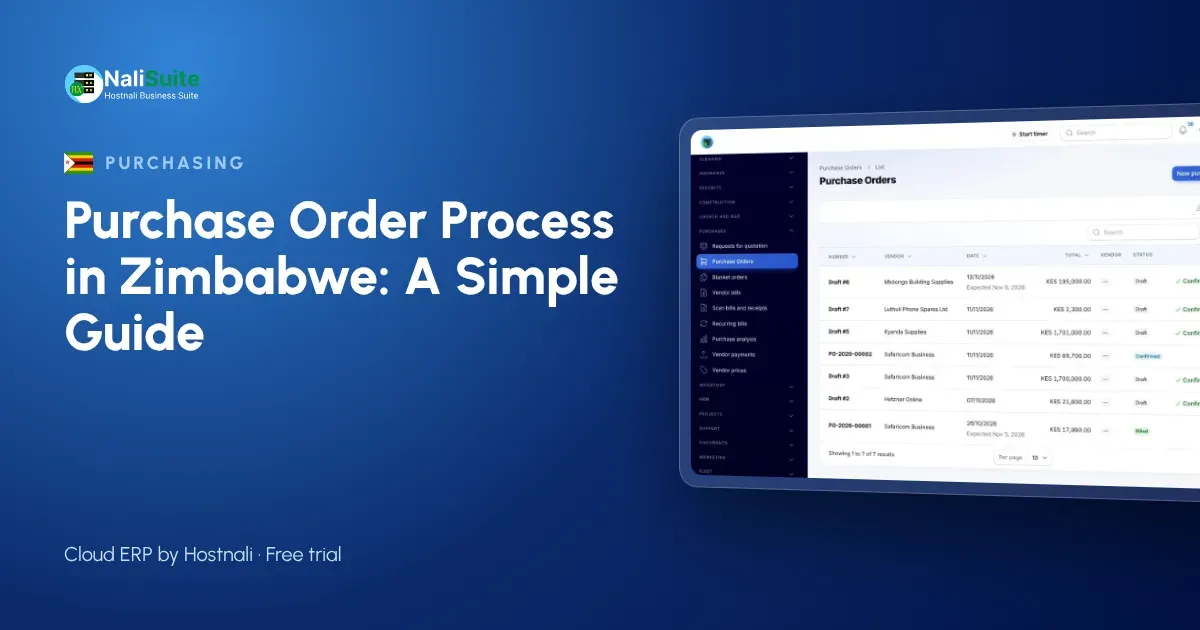
This guide shows how to run purchases through a simple purchase order process.
A day in the life of an agro-dealer in Mutare
Imagine an example agro-dealer in Mutare buying seed, fertiliser and chemicals before the planting season. Orders went to several suppliers by phone, and deliveries came in batches over weeks. The owner could never be sure which bills were for which delivery.
With purchase orders, each order is approved and sent as a PO with agreed prices. Every delivery is checked against its PO and recorded as received, including partial deliveries. Supplier invoices are matched to the PO and the deliveries, so the dealer pays exactly for what came.
Why buying without POs costs money
The owner of a growing business cannot approve every order by phone forever. A purchase order process lets you hand buying to your team while still knowing exactly what was ordered, received and paid.
Building the process
- A purchase request records the item, quantity and purpose.
- The approver checks the need and the budget.
- A purchase order goes to the supplier.
- The delivery is checked and recorded.
- The bill is matched with the PO and delivery, then paid.
Matching order, delivery and bill
Before any bill is paid, compare it with two other documents. Accountants call this three-way matching:
| Paper | Says | Checked against |
|---|---|---|
| PO | What was ordered and the price | The bill |
| Delivery record | What came | The PO and the bill |
| Bill | What is owed | The PO and the delivery |
If all three agree, pay. If they don’t, ask the supplier before paying. Most differences are honest mistakes, but they only get fixed if someone looks.
What a good purchase order shows
Every PO should answer five questions: who is buying, from whom, what exactly, at what price and when it must arrive. Add your payment terms and a unique number, and ask the supplier to quote that number on the delivery note and bill.
Setting approval limits
Set a limit per person or per department. Requests under the limit are approved by the manager; anything above it goes to the owner. The owner then spends time only on the purchases that matter.
Fiscalised invoices and supplier records in Zimbabwe
Keep each supplier’s BP number on their record, and check that the invoices you receive are fiscalised as ZIMRA requires and show the details correctly. Store them with the matched bill.
Confirm the current VAT rate and invoice requirements with ZIMRA, and set your tax rates in your system yourself. NaliSuite lets each business keep its own rates up to date.
Prices, currencies and partial deliveries
Zimbabwean suppliers may quote in US dollars or ZiG, and prices can change between quote and delivery. Put the currency and price on the PO and ask the supplier to confirm before dispatch.
Seasonal goods often arrive in several deliveries. Record each one against the PO so you always know what is still outstanding and the final bill can be matched line by line.
Pay each matched bill by bank transfer quoting its number, and reconcile the account at month end so nothing is paid twice.
For businesses that buy from both formal suppliers and informal traders, keep a simple rule: anything without a proper invoice still gets a PO and a delivery record, and the payment is noted against it. Your records then show every dollar spent, not only the purchases that came with paperwork. See bank reconciliation in NaliSuite.
Putting it into a system
You can run this process on paper, but software makes it much easier. In NaliSuite Purchases, requests, approvals, purchase orders and supplier bills live in one flow. Receiving updates inventory automatically, and matched bills post to accounting without anyone typing them again.
Frequently asked questions
Which currency should purchase orders use?
Use the currency you agree with the supplier, often US dollars. NaliSuite handles several currencies, so the PO, the bill and the payment match.
What should I check on supplier invoices?
That they are fiscalised as ZIMRA requires and show the supplier’s details, the items, prices and any VAT.
Who should approve purchase orders?
Usually a department head or manager for everyday purchases, and the owner for large or unusual ones. Set the limits in your system.
Can suppliers see our purchase orders?
They receive each PO by email or WhatsApp and should quote its number on their delivery note and bill.
Try NaliSuite
Run purchases, stock and accounting together in NaliSuite, from $2.10 a month with a free trial. View plans.