 USD
 KES - Kenya
 UGX - Uganda
 TZS - Tanzania
 RWF - Rwanda
 NGN - Nigeria
 ZAR - South Africa
 GHS - Ghana
 ETB - Ethiopia
 ZMW - Zambia
 USD - International

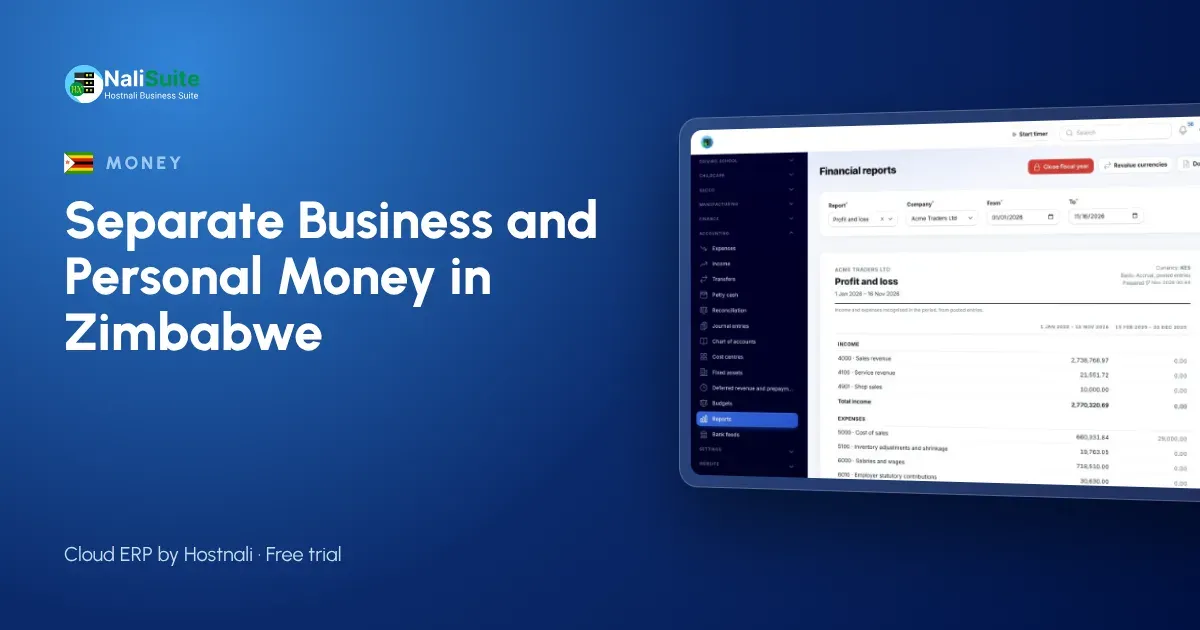
Keeping business and personal money apart is hard enough with one currency. In Zimbabwe, many small businesses handle US dollar cash, US dollar bank balances, local currency and card or online payments at the same time, and the owner’s household runs on the same mix. Without a clear structure, a few weeks of trading can leave the business’s money scattered across pockets, accounts and wallets that also pay for groceries and school fees.
This guide sets out a structure that works for a multi-currency small business, then covers owner pay, cash handling and records.
The account map
Think of the business as needing its own set of “money boxes”, one for each currency and channel you actually use:
| Box | Used for | Rule |
|---|---|---|
| Business USD bank account | Card and transfer receipts in USD, supplier payments, owner pay | Only business transactions |
| Business local-currency account | Receipts and payments in local currency | Only business transactions |
| Cash float | Change and small purchases at the counter | Counted daily, topped up from the bank, never used for personal spending |
| Personal accounts | Everything at home | Funded only by the owner’s pay |
If your business is registered with the Companies and Intellectual Property Office of Zimbabwe (CIPZ) and has a BP number from ZIMRA, banks will usually ask for those documents to open accounts in the business name.
Handling cash properly
Cash, especially US dollar cash, is where most mixing happens. A few rules help:
- Count and record takings every day, by currency.
- Bank them regularly, rather than holding large amounts or paying suppliers straight from the till.
- Keep a fixed float for change, and record every small payment made from it with a slip.
- Never take personal cash from the till. If you need cash for home, transfer your pay to your personal account and withdraw from there.
Paying yourself
Decide on a fixed amount, in a fixed currency, on a fixed day.
- Sole traders take drawings: a transfer from the business account to the personal account. Drawings are not a business expense.
- Company owners who work in the business are usually paid a salary through payroll, with the deductions that apply set up in the system; NaliSuite’s Payroll app handles payslips and the cost entries. Ask your accountant about the tax treatment of salary and dividends.
Choosing the currency matters: if you are paid in US dollars but the business earns mostly in local currency, your pay depends on the exchange rate. Agree a sensible approach with your accountant and stick to it.
Moving personal costs out
School fees, rent at home, household shopping, fuel for the family car and support for relatives are paid from your personal accounts. If the business lends you money in an emergency, record it as a loan to the owner, in the currency it was paid, and repay it.
Mixed-use items, such as a vehicle used for deliveries and family trips, need a split agreed with your accountant and recorded consistently.
Recording and converting
Receipts for every cost
Keep the supplier’s fiscalised invoice or receipt for every business purchase. In NaliSuite Purchases, a photographed bill is read by Document AI so the supplier, lines and tax are filled in for you to check.
One reporting currency
Your books should convert every transaction into one reporting currency at a consistent rate, usually US dollars, so the business’s results make sense. Our guide to reading a profit and loss statement in Zimbabwe explains why exchange gains and losses should sit on their own line. Check ZIMRA’s requirements on currency for tax returns with your accountant.
A weekly reconciliation
Each week, go through every business account and the cash record and explain every line. Bank reconciliation imports statements and suggests matches against invoices and bills, so anything personal stands out.
An example: Rudo’s pharmacy in Mutare
Rudo owns a small pharmacy in Mutare. Customers pay in US dollar cash, by card and sometimes in local currency. Until last year, she paid suppliers from whichever account had money, took cash home from the till and paid her children’s school fees by card from the business account.
Her new structure:
- Two business accounts, one for each currency, plus a counted float.
- US dollar cash banked three times a week.
- A fixed monthly salary through payroll, paid into her personal account.
- School fees and household costs from her personal account only.
- Supplier invoices photographed and matched to payments.
After a quarter of clean records, she can see that her margin on chronic medication is steady while over-the-counter lines vary with supplier prices, and that holding local currency for too long before paying suppliers cost her money. She now pays local-currency suppliers within days.
Frequently asked questions
Do I need separate accounts for each currency?
If you trade in more than one currency, separate business accounts per currency make reconciliation and reporting much easier.
Are drawings a business expense?
No. They are profit taken out by the owner and do not reduce taxable profit.
What about online payments?
Make sure card and online payments settle to a business account, never a personal one.
Will this help me get a loan?
Yes. Lenders read business statements to judge repayment capacity; see our guide to records for a business loan in Zimbabwe.
Try NaliSuite
Keep a multi-currency business on its own books with NaliSuite Accounting, from $2.10 a month with a free trial. See the plans.