 USD
 KES - Kenya
 UGX - Uganda
 TZS - Tanzania
 RWF - Rwanda
 NGN - Nigeria
 ZAR - South Africa
 GHS - Ghana
 ETB - Ethiopia
 ZMW - Zambia
 USD - International

Running a business in Zimbabwe means keeping track of more than one currency. Customers may pay in US dollars cash, by bank transfer, by card or in local currency; suppliers may price in one and invoice in another. Against that background, it is tempting to judge the business by the cash in the drawer at closing time. The profit and loss statement (P&L) gives a far clearer answer, but only if it is prepared and read with the currency question in mind.
This guide starts with the mistakes that most often distort a Zimbabwean P&L, then explains each line and how to read it.
Five mistakes that distort profit
1. Adding currencies together without converting
The same figure in US dollars and in local currency is not the same amount of money. If sales in both are added to “revenue” without converting at the rate on the day, the P&L is meaningless. Choose one reporting currency, most businesses use US dollars, and convert every transaction at a consistent rate. Check ZIMRA’s requirements for the currency of your tax returns with your accountant.
2. Treating exchange movements as trading profit
When you hold local currency and its value moves, you make an exchange gain or loss. Show it on its own line. Otherwise a good month for the exchange rate can hide a bad month for trading, or the opposite.
3. Counting stock purchases as costs
Goods bought but not yet sold are an asset, not an expense. Cost of sales should include only what you actually sold, which requires a stock count at the end of each period.
4. Leaving out cash sales
Unrecorded cash sales understate profit. That may feel harmless until you need a loan, a tender or a partner, and your books show a business weaker than the real one.
5. Paying personal costs from the business
Fuel for the family car, groceries and school fees paid from takings make expenses look higher. Our guide to separating business and personal money in Zimbabwe explains how to keep them apart.
The lines, one by one
Revenue. All sales for the period in your reporting currency, excluding VAT if you are registered. Fiscalised invoices and receipts are your evidence; your fiscal device or system records should agree with revenue in the books. Ask ZIMRA what applies to your business.
Cost of sales. The cost of goods or materials sold, converted at the rate when you bought them.
Gross profit and gross margin. Revenue minus cost of sales, and that figure as a percentage of revenue. Track the percentage every month.
Operating expenses. Wages, rent, electricity and generator or solar costs, fuel and transport, internet and phone, bank and card charges, security, repairs, depreciation.
Operating profit. Gross profit minus operating expenses: the result of trading.
Exchange gains and losses. Shown separately, as above.
Finance costs and tax. Interest and the income tax charge. Your accountant works out the tax figure.
Net profit. What remains for the owners.
Reading it: a hardware wholesaler in Bulawayo
Tendai runs a hardware wholesaler in Bulawayo and reports in US dollars. His P&L for the last quarter, against the same quarter last year:
| Line | Movement | What Tendai learns |
|---|---|---|
| Revenue | Up 9% | More contractor accounts in Harare |
| Gross margin | 26% → 23% | Supplier prices rose; his price list was updated late |
| Fuel and transport | Up 20% | Deliveries to Harare added a long route |
| Exchange loss | New line | Local currency held for two weeks before paying suppliers |
| Net profit | Down | Trading and exchange both contributed |
Without the separate exchange line, he would have blamed everything on the new route. With it, he sees two problems: update prices faster when suppliers change theirs, and pay local-currency suppliers sooner rather than holding the balance.
Reading habits that help
- Look at the same month last year, not only last month, to remove seasonal effects.
- Watch margin more than revenue. Revenue is easy to grow at a loss.
- Keep one-off items separate, such as selling a vehicle or an insurance payout.
- Review monthly. An annual P&L is for tax; a monthly one is for running the business.
For the cash side, which matters a great deal when currencies move, see our cash flow tips for Zimbabwean businesses.
Producing an accurate P&L every month
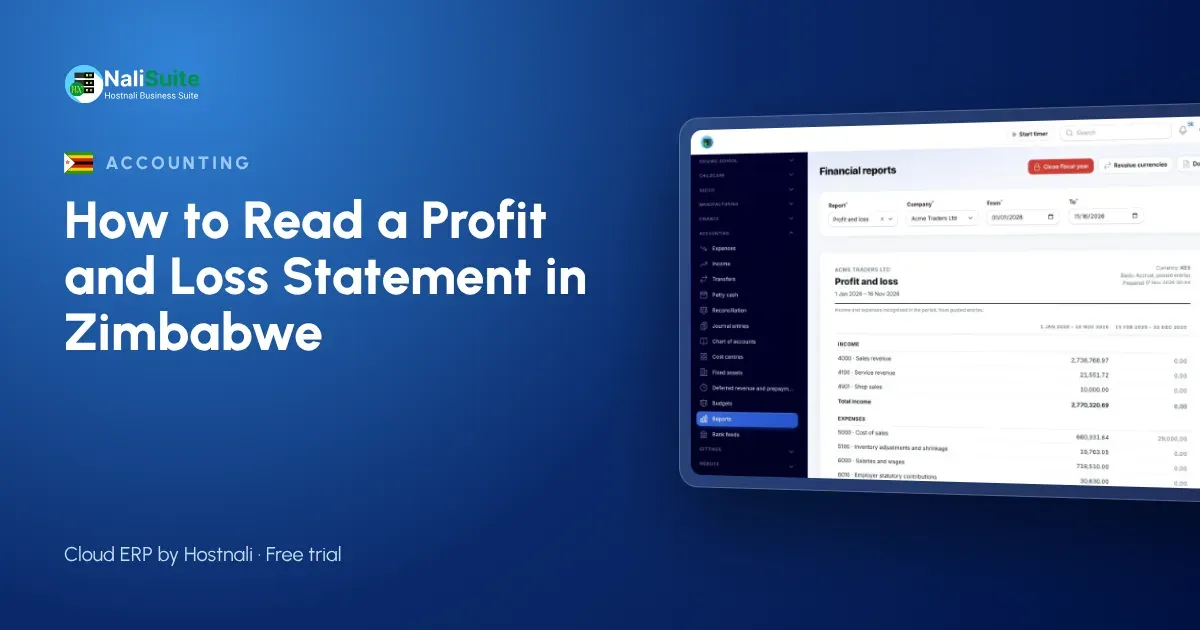
NaliSuite Accounting records each sale, supplier bill and payslip as it happens and builds the profit and loss statement, balance sheet and cash flow statement automatically, with the previous period alongside. Invoicing and online payments post receipts against the right invoice, and bank reconciliation matches statements to the books so missing or duplicated entries are caught.
Frequently asked questions
Which currency should my P&L be in?
Pick one reporting currency, most often US dollars, and convert every transaction consistently. Check ZIMRA’s requirements for tax returns with your accountant.
What is an exchange gain or loss?
The change in value of money or balances you hold in another currency. Show it separately from trading profit.
Why does my profit differ from the cash I have?
Profit counts sales and costs when they happen. Cash moves with customer payments, stock purchases, loans and owner’s drawings.
How often should I read my P&L?
Every month, and compare with the same month last year.
Try NaliSuite
See your real trading profit every month. NaliSuite starts at $2.10 a month with a free trial. See the plans.